You don’t rank #1 in ChatGPT the way you rank in Google. You earn mentions and citations. To get them, make sure AI tools can crawl your site, find the questions your buyers ask, answer each one clearly at the top of a page, back it up with real proof, show up on the sites AI already trusts in your industry, and track it every month.
Clients ask me this almost every week now: “How do we show up in ChatGPT?” Most of the advice online is either a list of hacks or a sales pitch for a tracking tool. I’ve been doing SEO for 16 years across more than 1,000 clients, and here’s the honest answer: getting into AI answers is built on the same things good SEO is built on, done with the AI answer in mind.
Below is the exact process I use with clients, what I skip, and real numbers from two client sites.
What does “ranking in ChatGPT” actually mean?
There’s no position #1 in ChatGPT. Answers change from one person to the next and from one day to the next. Research from SparkToro, reported by Ahrefs, found there’s less than a 1 in 100 chance ChatGPT gives the same list of brands in any two responses to the same question.
So instead of a ranking, you’re aiming for two things:
- A mention: the AI names your business in its answer.
- A citation: the AI links to your page as a source.
They’re not the same thing. A business can be mentioned often and still rarely be cited, which means the AI is learning about it from other sites, not from its own pages. I track both separately for every client.
Your goal is to show up for more of the questions that matter, more often, across ChatGPT, Perplexity, Google’s AI Overviews and AI Mode, and the other AI tools your buyers use.
How do ChatGPT and other AI tools pick their sources?
When someone asks a question that needs current information, AI tools search the web first, then write an answer from what they find. Three things matter here:
- One question becomes many. A single question like “who’s the best AV company in Denver?” gets broken into several searches behind the scenes: pricing, reviews, services, location. Pages that answer those follow-up questions have more chances to be pulled in.
- They favor pages they can understand and trust. Clear answers, real expertise and consistent information about the business.
- Every platform is different. ChatGPT, Perplexity and Google’s AI features don’t cite the same sources for the same question, and the sources change with the prompt and the intent behind it.
That’s why I never assume the sites with the most traffic will get the most AI citations. I check what each platform actually cites for my client’s questions, then work backward.
How to rank in ChatGPT and AI search: my 8-step process
Step 1: Make sure AI tools can find your site
If AI tools can’t crawl your pages, nothing else matters. Check these first:
- Your robots.txt file. Go to yoursite.com/robots.txt. If you see
Disallow: /under OAI-SearchBot (the crawler that powers ChatGPT search results), ChatGPT won’t show your pages in its search answers. GPTBot is OpenAI’s training crawler, and blocking it is a separate business decision. OpenAI explains the difference here. - Your firewall or CDN settings. Some hosts and services like Cloudflare can block AI crawlers automatically. Check that it’s a choice you made on purpose.
- Indexing in Google and Bing. Google says a page must be indexed and eligible to show in Search to appear in its AI features. Set up Google Search Console and Bing Webmaster Tools and submit your sitemap to both.
- The basics. Pages load fast, work on mobile, and the main content isn’t hidden behind JavaScript that crawlers struggle to read.
Step 2: Build your question set
Keywords still matter, but AI search runs on questions. Make a list of 20 to 50 questions your buyers would type into ChatGPT. Sort them by where the buyer is:
- Learning: “How much does a commercial video conferencing system cost?”
- Comparing: “What should businesses look for in an AV integrator?”
- Ready to hire: “What is the best commercial AV company in Colorado?” or “Who installs digital signage systems in Colorado?”
Those are real questions I test for a commercial AV client. For a senior healthcare client, the list covers in-home care, Medicare coverage, dementia care and finding a provider. Good places to find them: your sales calls and emails, Google’s “People also ask” box, Reddit threads in your industry, and the follow-up questions AI tools suggest after their answers.
Step 3: Check who AI cites today
Run each question in ChatGPT, Perplexity and Google. For every question, I record four things:
- Is the brand mentioned?
- Is the website cited?
- Which competitors are mentioned?
- Which sources does the AI rely on?
Don’t rely on one test. Answers vary by location, personalization, platform and timing, so you’re looking for patterns across your whole question set, checked on a regular schedule. The sources column is gold. It tells you exactly which pages and sites the AI trusts for your topic, and what your page needs to beat.
Step 4: Write answer-first pages
This is the biggest change I make on client pages. Put the direct answer at the top, then explain it. Don’t make the reader (or the AI) scroll through three paragraphs of background first.
There’s data behind this. Kevin Indig’s analysis of 1.2 million ChatGPT citations, covered by Ahrefs, found that 44.2% of citations came from the first 30% of a page.
The format I use:
- A heading that matches the question the buyer actually asks.
- A 40 to 60 word answer right under it that makes sense on its own.
- The detail after that: steps, costs, examples, what to watch out for.
- Specifics, not fluff: real numbers, names, places and timeframes.
Notice the bold answer at the top of this article. That’s the format.
Step 5: Cover the whole topic, not one page
One great page isn’t enough. AI tools look for the site that clearly knows the whole subject. That means a main page for each service or topic, supporting articles that answer the related questions, and internal links that connect them.
Football DNA, a UK football (soccer) coaching membership, is a good example. Instead of broad descriptions of the membership, we built detailed pages around what members actually search for: football coaching, plays, plans, sessions and formations. Each one explained how the membership works, where it’s used and what to consider before buying. Then we added supporting articles around related questions and linked everything together.
The results:
| Keyword rankings | Before | After |
|---|---|---|
| Top 3 | 12 | 149 |
| Top 10 | 21 | 510 |
| Top 20 | 29 | 645 |
| Total ranking keywords | 65 | 3,554 |
Those are search rankings, not AI citations, but they show what full topic coverage does. It’s the same foundation AI tools draw on.
Step 6: Add proof and a solid trust foundation
AI tools lean toward businesses they can verify. Before you worry about anything fancy, get these right:
- Real proof on the page: results, case studies, reviews, photos of your work and credentials. If you use AI to help you write, feed it your own proof first. Otherwise you get the same generic page as everyone else.
- Business details that match everywhere: the same name, address, phone number and services on your website, Google Business Profile and directory listings.
- Real authors: who wrote it, and why they know what they’re talking about.
- Accurate schema markup. I use Organization or LocalBusiness (or a specific type like MedicalOrganization, LegalService or HVACBusiness when it fits), Service on service pages, Article or BlogPosting on articles, BreadcrumbList, and Product for e-commerce.
My rule for schema: it should describe the page accurately, not try to game anything. Google says there’s no special schema you need to add for its AI features. It helps search engines understand your page, but it won’t get you into AI answers on its own.
Step 7: Show up where AI looks in your industry
AI answers are built from more than your website. It pays to play in the same ecosystem as your business. In my client work:
- Healthcare: AI leans on sources like Medicare.gov, NIH, Cleveland Clinic and Mayo Clinic. Your content should be accurate enough to sit next to them, and link to them where it helps the reader.
- Legal: government websites, state statutes, court resources and law firms publishing useful, location-specific content.
- Commercial AV, electrical and technical work: manufacturer documentation, industry associations and specialized service providers.
I also watch Reddit, YouTube and other community sites, because real discussions and demonstrations shape how people research. Take part honestly there: answer questions and be helpful. Don’t fake it. Google’s own guidance says “seeking inauthentic ‘mentions’ across the web isn’t as helpful as it might seem.”
Step 8: Track it and tie it to leads
A mention in an AI answer is nice. A phone call is better. I track AI visibility with four tools:
- Semrush to monitor AI visibility, brand mentions and cited pages over time.
- Manual tests of the question set from Step 2, on a regular schedule.
- Google Search Console for search performance. It doesn’t have a separate report for AI Overview citations, so use it alongside the others.
- Analytics for referral traffic from ChatGPT, Perplexity and other AI tools where it’s available.
Then connect it to what matters: qualified traffic, leads, calls and sales. If you do SEO or AEO for clients, that’s the part that keeps them. They’re paying for more customers, not for a visibility score.
What I skip (and what Google says about it)
In May 2026, Google published its own guide to optimizing for its generative AI features. The short version: optimizing for AI search is still SEO. It lines up with what I’ve seen on client sites. Here’s what I don’t spend client money on:
- llms.txt as a ranking tactic. The idea makes sense, but there’s little evidence it improves visibility or citations, and Google says its Search doesn’t use these files. On a site that already has its fundamentals done, it’s a cheap experiment. It’s not a substitute for good SEO.
- Chopping content into tiny chunks. Google says you don’t need to split pages into small pieces for AI. Write for your reader.
- FAQ schema on every page. Google restricted FAQ rich results in 2023, so adding it everywhere doesn’t do what it used to. A visible FAQ section that answers real questions is still useful.
- HowTo markup. Google discontinued How-to rich results.
- Fake reviews, ratings or mentions. Never.
- Mass-produced AI pages. Publishing hundreds of thin pages to game rankings or AI answers can break Google’s scaled content abuse policy.
Real results: what this looks like on a new website
Seniority Healthcare provides physician-led senior healthcare across multiple states. When we started, it was a brand new website with no SEO or AEO value at all.
We built complete content around in-home care, dementia care, medication management, primary care for seniors and the other questions families ask. The biggest changes: answering specific questions directly, going deeper on medically relevant topics, cleaning up heading structure, and linking informational content to the right service pages.
Between March and May 2026:
| Metric | March | May |
|---|---|---|
| Tracked AI visibility score | 1 | 6 |
| AI mentions | 2 | 13 |
| Cited pages | 4 | 25 |
Over the same stretch, users grew from 66 a month to more than 600 a month, and within six months the site reached the top 10 for “home senior care,” a keyword with a difficulty score of 80.
One honest note: that’s measured AI visibility from tracking tools. Tying one specific ChatGPT answer to one specific page edit takes individual citation records. What the numbers do show is the pattern I see over and over. AI visibility doesn’t need a separate strategy. It comes from making useful content more complete, easier to access, more trustworthy and easier to pull an accurate answer from.
How long does it take to show up in ChatGPT?
Expect months, not days. For Seniority Healthcare, a brand new site, measurable AI visibility gains showed up within about three months of steady work. Sites with existing authority can move faster. Sites in crowded industries can take longer. Anyone promising AI placement in a week is selling you something.
Frequently asked questions
Is AEO different from SEO?
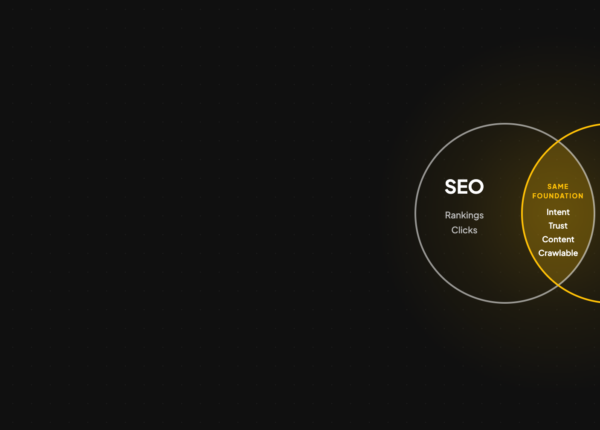
Less than most people say. AEO (answer engine optimization) and GEO (generative engine optimization) build on the same fundamentals: search intent, topic coverage, clear structure, technical health and trust. The difference is in how you plan and write: around the questions buyers ask AI, with clear answers and real proof. I break down exactly what changes in AEO vs SEO.
Can a small business show up in ChatGPT?
Yes. AI tools often answer local and niche questions, where a small business with clear, specific, well-proven pages can beat bigger brands. Start with your most important service and the questions buyers ask about it.
Do I need llms.txt to rank in ChatGPT?
No. There’s little evidence it improves visibility, and Google says its Search doesn’t use it. Fix crawlability, content and trust first. Treat llms.txt as an optional experiment.
Do I need special tools to track AI visibility?
Not to start. You can test your question set by hand in ChatGPT, Perplexity and Google and record the results in a spreadsheet. Tools like Semrush make it easier to track over time and at scale.
What’s the difference between a mention and a citation?
A mention is when the AI names your business. A citation is when it links to your page as a source. You want both, and you should track them separately.
Get the full step-by-step process
This article covers the process. The AEO Blueprint gives you everything to put it to work: how to build your question set, the answer-first page template, the trust foundation checklist, my tracking sheet and a one-page AEO checklist for every page. It’s a 15-page PDF for $47, instant download.
Building pages for services or locations? The Service Page Blueprint and The City Page Blueprint show you how to build each one section by section. New to SEO? Start with how to become an SEO specialist.
Sources: Google Search Central, Optimizing your website for generative AI features on Google Search (May 2026); Google Search Central blog, changes to HowTo and FAQ rich results (August 2023); OpenAI crawler documentation; Ahrefs, How to Rank on ChatGPT: What Actually Works (March 2026), including SparkToro and Kevin Indig research. Client results are from Richard Hale Media’s own tracking.

Richard Hale has done SEO for 16 years. He's a Top Rated freelancer on Upwork with a 100% Job Success Score across more than 1,000 clients, and he runs the digital marketing agency Richard Hale Media. He started out writing articles on HubPages, and today he teaches people how to learn SEO, land clients and grow a business they're proud of.
Related posts
-
How to Become an SEO Specialist in 2027 (Even With No Experience)
How to become an SEO specialist from scratch: a 90-day plan, real pay ranges, whether certifications matter, and...
31 October 202603LikesBy Richard Hale -
How to Rank in ChatGPT and AI Search (2027 AEO Guide)
How to get your business mentioned and cited in ChatGPT, Perplexity and Google's AI answers: my 8-step process,...
1 November 202601LikeBy Richard Hale -
AEO vs SEO: What’s Different and What Stays the Same (2027)
AEO vs SEO explained by an SEO with 16 years and 1,000+ clients: what stays the same, the...
1 November 202601LikeBy Richard Hale