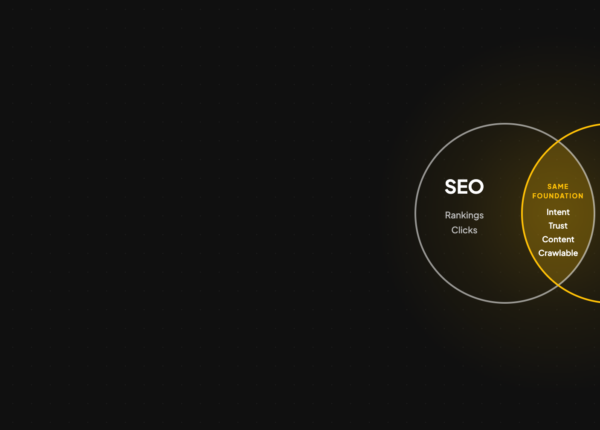
SEO earns rankings and clicks in search results. AEO (answer engine optimization) earns mentions and citations inside AI answers from ChatGPT, Perplexity and Google’s AI Overviews. They’re built on the same foundation: crawlable pages, search intent, real expertise and trust. What changes is how you plan pages, how you write the answer, and how you measure results.
Every few months someone announces that SEO is dead and AEO is the new thing. Then someone else says AEO is just SEO with a new name. After 16 years in SEO and more than 1,000 clients, my answer is in the middle, and it’s closer to the second one. Most of the work is the same. A few things really are different, and those are what this article is about.
AEO vs SEO at a glance
SEO
AEO
Goal
Rank in search results and earn the click
Get mentioned or cited in AI-generated answers
Where it shows up
Google and Bing results, local packs, featured snippets
ChatGPT, Perplexity, Google AI Overviews and AI Mode, other AI assistants
How people search
Short keywords
Full questions and follow-up questions
What “winning” looks like
A top position and a visit to your site
Your business named in the answer, or your page linked as a source
How you measure it
Rankings, clicks, traffic, leads
Mentions, citations, AI visibility, AI referral traffic, leads
The foundation
The same: crawlable pages, search intent, topic coverage, proof and trust
What is SEO?
SEO (search engine optimization) is the work of helping your pages rank in search engines like Google and Bing so the right people find and visit your site. It covers keyword research, on-page content, technical health, internal links, local SEO and earning links and mentions from other sites.
What is AEO?
AEO (answer engine optimization) is the work of helping AI tools understand, trust and use your content when they answer a question. The goal is to be the business they name, or the page they cite as a source, when someone asks ChatGPT or Google’s AI something like “who’s the best roofer near me?” or “how much does in-home senior care cost?”
AEO vs GEO vs SEO: are they different things?
Mostly they’re different names for overlapping work. GEO (generative engine optimization) usually means the same thing as AEO: showing up in AI-generated answers. Some people use AEO for getting your content pulled into an answer and GEO for how AI tools describe your brand in general. In practice, the work is the same.
Google’s view is simple. In its May 2026 guide to optimizing for generative AI features, Google says that from its perspective, optimizing for generative AI search is still SEO. I agree. I use the AEO label because it’s what clients search for and ask about, not because it’s a separate discipline.
What stays the same
My approach to AEO builds on the same fundamentals I’ve used in SEO for over 15 years. These matter just as much for AI answers as they do for rankings:
AI tools have to be able to find you. Pages need to be crawlable and indexed. Google says a page must be indexed and eligible to show in Search to appear in its AI features.
Search intent still decides everything. Whether someone types a keyword or asks a question, the page that best answers what they actually want wins.
Topic coverage still builds authority. A main page for each service or topic, supporting articles for the related questions, and internal links connecting them.
Trust still matters most. Real expertise, real proof, clear authors and business details that match everywhere.
Original content still beats rehashed content. Google’s guidance pushes for content with a unique point of view, like first-hand experience, not a rewrite of what already ranks.
What’s actually different
1. You plan around questions, not just keywords
People talk to AI tools in full questions, and they ask follow-ups. Behind the scenes, one question gets broken into several searches. So instead of a keyword list alone, I build a question set: 20 to 50 real questions buyers ask, sorted by whether they’re learning, comparing or ready to hire.
2. The answer goes first
SEO pages often warm up before they get to the point. For AEO, the direct answer goes right under the heading, in 40 to 60 words that make sense on their own, then the detail follows. AI tools pull passages, not whole pages, so a clear answer near the top is easier to use. (The bold paragraph at the top of this article is an example.)
3. A mention isn’t a ranking
There’s no position #1 in ChatGPT. Answers change from person to person and day to day. You’re aiming to be mentioned or cited for more of the questions that matter, more often. And a mention and a citation aren’t the same thing: a mention names your business, a citation links to your page. I track them separately.
4. Where you show up off your site matters more
AI answers lean on sources across the web, not just your website. It pays to play in the same ecosystem as your business: for healthcare clients that means sources like Medicare.gov, NIH and Mayo Clinic; for legal clients, government and court resources; for technical trades, manufacturer documentation and industry associations. Reddit, YouTube and review sites matter too, as long as you take part honestly.
5. Measuring it is harder
SEO has decades of tools for rankings and traffic. AEO tracking is newer. I use Semrush to monitor AI visibility, mentions and cited pages, plus manual tests of the question set, Google Search Console and analytics for AI referral traffic. Search Console doesn’t separate AI Overview citations, so no single tool gives the full picture yet. Whatever you track, tie it back to leads and sales.
What I see on client sites: one effort, both results
The clearest proof that AEO and SEO aren’t separate jobs is what happens when you do the work well. Seniority Healthcare, a physician-led senior healthcare company, started as a brand new website with no SEO or AEO value. We built complete content around in-home care, dementia care, medication management and the questions families ask, answered those questions directly, cleaned up heading structure and linked articles to the right service pages.
That one body of work moved both sides at once:
SEO results
AEO results (March to May 2026)
Users grew from 66 to 600+ a month
AI visibility score went from 1 to 6
Top 10 for “home senior care” (difficulty 80) within six months
AI mentions went from 2 to 13
Cited pages went from 4 to 25
To be clear, those AI numbers come from tracking tools. Tying one specific AI answer to one page edit takes individual citation records. But the pattern is one I see over and over: AI visibility doesn’t need a separate strategy. It comes from making useful content more complete, easier to access, more trustworthy and easier to pull an accurate answer from.
For the full process I use, including the question set, the answer-first format and tracking, read my guide on how to rank in ChatGPT.
Common AEO myths
“SEO is dead.” AI tools search the web and lean on pages search engines already trust. Weak SEO usually means weak AI visibility.
“You need llms.txt.” There’s little evidence it improves visibility or citations, and Google says its Search doesn’t use these files. It’s a cheap experiment, not a strategy.
“You need special AI schema.” Google says there’s no special schema you need for its AI features. Use schema that accurately describes the page and the business, like Organization or LocalBusiness, Service, Article and BreadcrumbList.
“Chop your content into tiny chunks.” Google says you don’t need to. Write clear, well-organized pages for people.
“More mentions, any way you can get them.” Google warns that seeking inauthentic mentions isn’t as helpful as it might seem. Earn them.
Should you learn AEO or SEO?
Learn SEO, and include AEO from day one. If you’re learning how to become an SEO specialist, the AEO pieces (question sets, answer-first writing, tracking mentions and citations) are what clients increasingly ask about, and very few people do them well yet. That’s an edge.
If you own a business, don’t hire one person for SEO and another for AEO. Hire someone who does both and reports on what matters: leads, calls and sales.
Frequently asked questions
Will AEO replace SEO?
No. AEO is built on SEO. AI tools search the web and favor pages that are crawlable, relevant and trusted, which is what SEO builds. Search results also still drive a large share of traffic. You need both, and the same work feeds both.
Is AEO the same as SEO?
Mostly. Google says optimizing for its AI features is still SEO. The differences are in planning (questions, not just keywords), writing (the answer first), off-site presence and measurement (mentions and citations instead of rankings).
What’s the difference between AEO and GEO?
Both are about showing up in AI-generated answers. Some people use AEO for getting content cited in an answer and GEO for how AI tools describe a brand overall. In day-to-day work, they’re the same job.
Do I need a separate AEO strategy?
No. Add AEO to your SEO strategy: build a question set, write answer-first pages, strengthen proof and trust, and track AI mentions and citations alongside rankings.
How do I measure AEO?
Track whether your brand is mentioned, whether your pages are cited, which competitors appear and which sources AI tools rely on for your key questions. Use a tool like Semrush plus manual tests, and check analytics for referral traffic from AI tools. Then tie it to leads.
Put AEO to work on your site
The AEO Blueprint is the step-by-step version: how to build your question set, the answer-first page template, the trust foundation checklist, my tracking sheet and a one-page AEO checklist for every page. It’s a 15-page PDF for $47, instant download.
Richard Hale has done SEO for 16 years. He's a Top Rated freelancer on Upwork with a 100% Job Success Score across more than 1,000 clients, and he runs the digital marketing agency Richard Hale Media. He started out writing articles on HubPages, and today he teaches people how to learn SEO, land clients and grow a business they're proud of.