To become an SEO specialist, learn from someone who gets real results, master the fundamentals (keyword research, on-page, technical, local SEO and now AEO), practice on a real website, and turn your first win into proof you can show a client or employer. With the right guidance, you can cover the essentials in about 90 days. No degree or certification required.
That’s the short version. The long version is below, along with the mistakes I made so you don’t have to make them too.
I’ve been doing SEO for 16 years. I’ve worked with more than 1,000 clients on Upwork with a 100% Job Success Score, and I run an agency, Richard Hale Media. I didn’t start with a mentor, a course or a plan. I started with a website that paid people to write.
How I got into SEO (and what my first year really looked like)
Sixteen years ago I was looking for ways to make money online and found HubPages, a site that paid authors to write articles. So I wrote. And somewhere along the way I learned there was a thing called SEO.
I started looking up keywords and noticed that tattoo topics got searched a lot. So I wrote about tattoos. Within a short period I was making $1,000 a month from those articles, and the writing took me about 10 hours a month. My 9-to-5 paid me the same $1,000 a month, and that took 80 hours. Same money for one-eighth of the time.
That was my light bulb moment. It was life changing.
I grew one of the most viewed profiles on HubPages, and people started noticing how well my articles ranked. Then they started asking if I could do the same for them. My very first client paid me $400 a month, and they found me through my HubPages content. I didn’t pitch anyone. My rankings were my portfolio.
The first year was a ton of trial and error. I failed a lot. But I never gave up, and I got results for those first clients fast, which led to more clients. That’s how a side hustle turned into a 16-year career.
I’m telling you this because it shows something most “how to become an SEO” guides skip: you don’t need permission to start. You need a website, a topic people search for, and the willingness to learn by doing.
Is SEO still worth learning in 2027?
Yes. I’ve been hearing “SEO is dying” for as long as I’ve been doing SEO, and that’s over 16 years now.
AI is disruptive. I’m not going to pretend it isn’t. Tools like ChatGPT and Perplexity are answering questions that used to go straight to Google, and I do expect AI to take some of search engine market share.
But not all of it, and not right away. Google still handles about 89% of all searches worldwide, according to StatCounter’s January 2026 data. AI search tools combined are estimated at roughly 3 to 5% of search. My personal prediction is that AI takes around 10% by 2030. Google is still king, and people still need search.
Here’s the part that matters for you: the skills overlap. The same things that help a page rank on Google (clear answers, strong structure, real expertise) are what get a page cited by AI tools. That second skill set is called answer engine optimization, or AEO. If you learn SEO now and include AEO from day one, you’re not learning a dying skill. You’re learning the one that’s evolving, ahead of most people who already do it. To see what that work looks like, here’s my step-by-step guide on how to rank in ChatGPT.
What does an SEO specialist actually do?
An SEO specialist helps a website get found by people searching for what it offers. Day to day, that usually means:
- Keyword research: finding what people search for and how often.
- On-page SEO: writing and optimizing pages so they clearly answer those searches.
- Technical SEO: making sure search engines can crawl and index the site. (I recently found a brand-new site with one checkbox in WordPress quietly telling Google not to index any of it. Small things matter.)
- Local SEO: helping local businesses show up in Google Maps and “near me” searches.
- Content strategy: planning what to publish and in what order.
- AEO and GEO: structuring content so AI tools quote it (here’s AEO vs SEO explained).
- Reporting: showing what’s working in terms a business owner cares about, like leads and sales.
Three ways to work as an SEO specialist (and what each pays)
There’s no single SEO career. There are three common paths, and they pay and feel very different.
| Path | What it looks like | Typical pay (US) |
|---|---|---|
| In-house | You do SEO for one company. Steady paycheck, one website, slower variety. | About $59K average at entry level, about $104K at senior level (Glassdoor) |
| Agency | You work on many client sites at once. Fast learning, heavier workload. | National averages range from about $67K to $97K depending on the source |
| Freelance / your own business | You find your own clients and set your own prices. Most freedom, most responsibility. | Commonly $50–$75/hour starting out, $150+/hour with experience; most freelancers sell monthly retainers |
I went the freelance route, and it’s the one I teach, because it’s the only path where your income isn’t capped by someone else’s salary bands. But all three are real careers. Pick the one that fits your life right now. You can always switch.
How to become an SEO specialist: your first 90 days
If I were starting over today with no experience, this is exactly what I’d do.
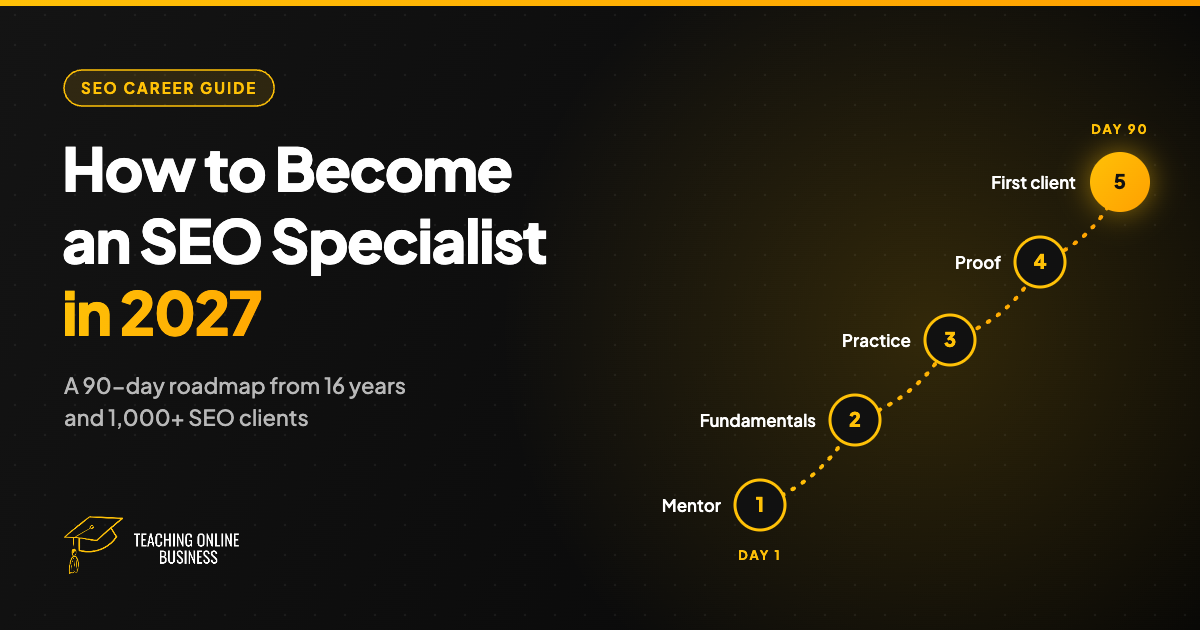
1. Get a mentor first
This is the big one. I’m proud that I figured SEO out on my own, and I wouldn’t change my story. But it took me years to learn tricks of the trade that a mentor could have taught me in a few weeks. I wasted a lot of time and probably lost money because of it.
Find someone who has actually done the work and gotten results, and learn from them. Join a community where people share what’s working right now. If you learn from a true expert for 90 days, you’ll learn everything you need to know to get started.
2. Learn the fundamentals, in the right order
Don’t try to learn everything at once. Start with how search engines find and rank pages, then keyword research, then on-page SEO. Add local SEO and technical basics next. Learn AEO alongside all of it, not as an afterthought.
3. Practice on a real website
Reading about SEO isn’t doing SEO. Start a simple site about something you know, or help a friend’s small business. Pick a topic people actually search for, like I did with tattoos, and try to rank for it. You’ll learn more from one page climbing (or not climbing) in Google than from ten courses.
4. Turn your results into proof
Once something works, document it. Before and after rankings, traffic going up, a phone call that came from Google. A one-page case study beats any certificate when you’re talking to a client or employer.
5. Land your first paying client
Your first client doesn’t have to be big. Mine paid $400 a month. Look to your network, local businesses, freelance platforms like Upwork, and your own content. Remember, my first client found me because my content ranked. When your SEO works, it becomes your best marketing.
Do you need an SEO certification?
Honestly, no. In 16 years, I’ve been asked for a certification maybe once or twice.
Clients and employers can tell a lot about you by talking to you. If you know your stuff, it shows in the first conversation. In my case, there’s nothing about SEO I can’t answer, and I got that from experience, not a certificate.
If you want a certificate, go for it. It won’t hurt. But don’t mistake it for experience. If you’re asking which program I’d recommend, I’m going to be upfront: the only one I recommend is the training here at TeachingOnlineBusiness.com. Yes, I’m biased. I built it from what actually worked for me and my clients, and I stand behind it 100%.
The biggest mistake beginners make
Learning from people who don’t actually do SEO.
There are a lot of people creating SEO content consistently, and they’re great at getting attention. That’s fine. But many of them don’t get real-world results. The same talking points go around over and over. If you’re going to learn from someone, learn from someone who’s worked in the trenches and can show you results.
The second mistake I see more and more: letting AI write your content with no direction. People tell AI to “write an article about X” and hit publish. The problem is everyone is doing the same thing, so everyone gets the same content. If you use AI, give it a detailed prompt with your own experience, examples and opinions. That’s what makes content unique, and unique content is what ranks and gets cited.
Free tools to start with
- Google Search Console: see what your site ranks for and spot indexing problems.
- Google Analytics 4: see where visitors come from and what they do.
- Google Business Profile: essential for local SEO.
- A keyword tool: Semrush and others offer free tiers, enough to learn keyword research.
You don’t need expensive tools to start. You need to know what to do with the free ones.
FAQ
How long does it take to become an SEO specialist?
With a good mentor, you can learn the fundamentals in about 90 days. Getting truly good takes real projects and time. I’m still learning after 16 years, because search keeps changing.
Is SEO a high-income skill?
It can be. Senior in-house SEO roles average over $100K, and experienced freelancers charge $150 an hour or more. Your income depends on your results and, if you freelance, on how you price and sell your services.
Can you learn SEO for free?
Yes, you can learn the basics free through practice and free tools. What costs you is time. Learning by trial and error took me years. A mentor shortens that dramatically.
Is SEO dead?
No. People have been saying that for 16 years. Google still handles roughly 89% of searches, and the skills that rank pages are the same ones that get them cited by AI. SEO is evolving, and AEO is part of that evolution.
Your next step
The fastest way to start practicing is to look at real businesses and spot what’s holding them back in Google. My free guide, 7 Signs a Business Needs SEO, shows you how to do that with nothing but a Google search. Thirty seconds per sign, and you’ll start seeing opportunities everywhere.
Sources: StatCounter Global Stats (January 2026) via Searchlab; AI search share estimates (SparkToro, Datos, SimilarWeb) via Searchlab; salary data from Glassdoor, Indeed, ZipRecruiter and Salary.com and freelance rates from SoloHourly, as compiled by GTM 80/20.

-
How to Become an SEO Specialist in 2027 (Even With No Experience)
How to become an SEO specialist from scratch: a 90-day plan, real pay ranges, whether certifications matter, and...
-
How to Rank in ChatGPT and AI Search (2027 AEO Guide)
How to get your business mentioned and cited in ChatGPT, Perplexity and Google's AI answers: my 8-step process,...
-
AEO vs SEO: What’s Different and What Stays the Same (2027)
AEO vs SEO explained by an SEO with 16 years and 1,000+ clients: what stays the same, the...